LET NATURE GUIDE YOUR QIGONG PRACTICE
/When someone asks me what Qigong practices I do, my answer is always the same: I practice according to the seasons!
The basic principle of Qigong and Traditional Chinese Medicine is to align your energy with nature. Every animal instinctually knows how to adapt to the seasons and maximize their Qi. Winter is a time to conserve and nourish, Spring is a time to move and grow, Summer is a time to sing and express, Late Summer is to balance and harvest and Autumn is a time to let go and prepare.
Each season offers us a gift of Qi that we can tune into and cultivate within ourselves. For example, the energy of Spring is rising yang Qi. The element is Wood, which has the characteristic of growth, resiliency and direction. The organ that is most active during Spring is the liver. Therefore, during Spring the best Qigong exercises balance the rising and falling action of Qi, expands the Qi in all directions, support the liver and cultivate growth.
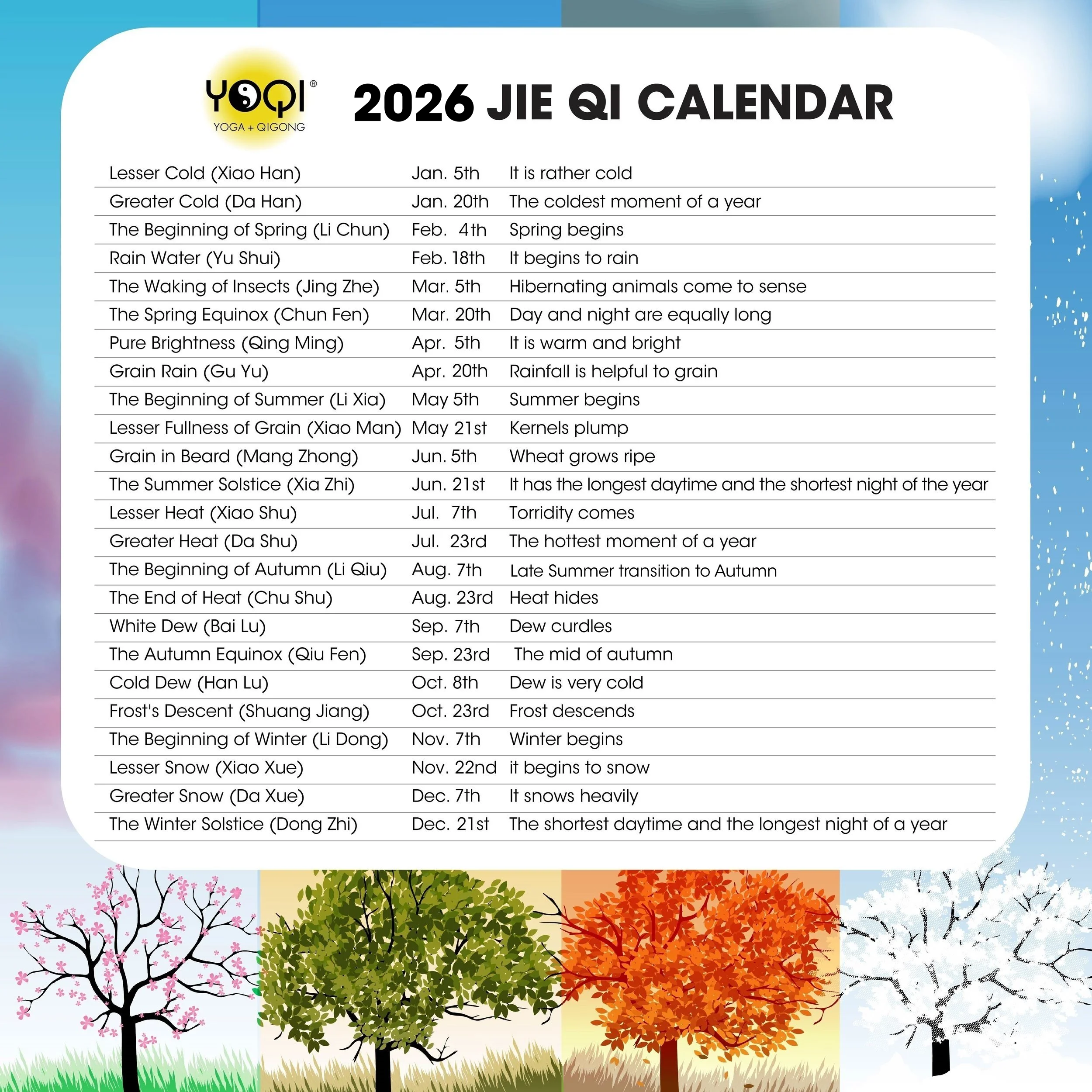
A great way to choose practice according to the season is to use the Jié Qì calendar. Seasonal energy revolves around the four great shifts of Yin and Yang that create one solar calendar year: the winter solstice, the spring equinox, the summer solstice and the autumn equinox. Connecting these four days are 24 terms that the Chinese call Jié Qì. Jié Qì were created by the farmers in ancient China to guide the agricultural affairs and farming activities. This precise seasonal calendar sets the dates of the seasons and holidays.
WHEN DOES LATE SUMMER BEGIN AND END?
The Jie Qi calendar is organized according to the natural cycles of Yin and Yang. In this calendar, Autumn officially begins on August 7 and reaches its peak at the Autumn Equinox. This transitional period is sometimes called the “Old Tiger of Autumn,” when the lingering heat of Summer meets the emerging energy of Autumn.
Late Summer is often characterized by unpredictable weather. The days may be hot and humid, while nighttime temperatures can fluctuate dramatically—from very warm to surprisingly cool.
The length of the Late Summer season depends on the latitude, longitude, and altitude of where you live. At higher elevations and latitudes, such as the High Tatra Mountains of Slovakia, Late Summer may be very short, with signs of Autumn arriving as early as August. In warmer regions, such as Southern California, Late Summer may continue until the end of September.
The Autumn Equinox marks the peak of the transition from Yang to Yin. After the equinox, Yin energy begins its full ascent and gradually becomes dominant. The signs of Autumn become more apparent: the scent of the air changes, the evenings grow colder, and the leaves turn their first shades of yellow before beginning to fall.
WHEN DOES WINTER END AND SPRING BEGIN?
Many people also ask when they should begin practicing Qigong for Spring. According to the Jie Qi calendar, Spring begins on February 4. Yet in many parts of the world, the weather is still cold and snowy at this time.
Like the transition from Summer to Autumn, February is a transitional period. Although it is not formally governed by the Earth Element in the same way as Late Summer, it is still an excellent time to practice Earth-centered Qigong and nourish the Spleen, Stomach, and Lower Dantian. This creates a strong, grounded foundation to balance the rising Wood energy of Spring.
Choosing routines according to seasonal cycles keeps your Qigong practice fresh, engaging, and connected to nature. There are more than 300 Qigong Flow movements in the YOQI® system—and there is no way to practice all of them in one week, nor do you need to!
That is why I developed the YOQI® system of the Six Phases of Qi Flow. Each seasonal routine applies the traditional principles of energy regulation to the changing seasons.
Simply select the SEASONAL ROUTINES category in the Video On Demand library and choose the seasonal series that corresponds with your hemisphere.
WHAT IF I LIVE NEAR THE EQUATOR OR IN THE TROPICS?
If you live near the equator or in a tropical climate, you may not experience dramatic seasonal changes. However, you can still align your practice with the natural cycles of energy. In many tropical regions, the rainy season may create Late Summer conditions for a longer period. This means you may benefit from spending more time with the Late Summer Series, which focuses on balancing the Earth Element and supporting the Spleen and Stomach.
My advice is to follow the Jie Qi calendar according to your hemisphere while also listening closely to your body and observing the natural world around you. Pay attention to the seasonal rhythms of the animal, insect, and plant kingdoms in your current location. Even in tropical climates, fruits such as mangoes and lychees flower and ripen during specific periods that may be hotter, drier, or damper. By connecting with local farmers and learning about the natural cycles of your unique habitat, you can deepen your Qigong practice and live in greater harmony with nature.
Ultimately, you will know that a practice is working when it helps you feel balanced, energized, and well.